Neo Ten supports the Belgian Crochet Coral Reef initiative !
“A nexus of art, science, mathematics, environmentalism, and community practice.”
Isabelle Dumont is currently coordinating the Belgian chapter of the international Crochet Coral Reef, an artistic and scientific initiative that combines collective craft, environmental awareness, and public participation. The project invites students and members of the public to crochet small coral-like forms. Each piece — whether simple or intricate — becomes part of a growing collective reef. Over the coming months, hundreds of these handmade fragments will be produced across Belgium through workshops and individual contributions.
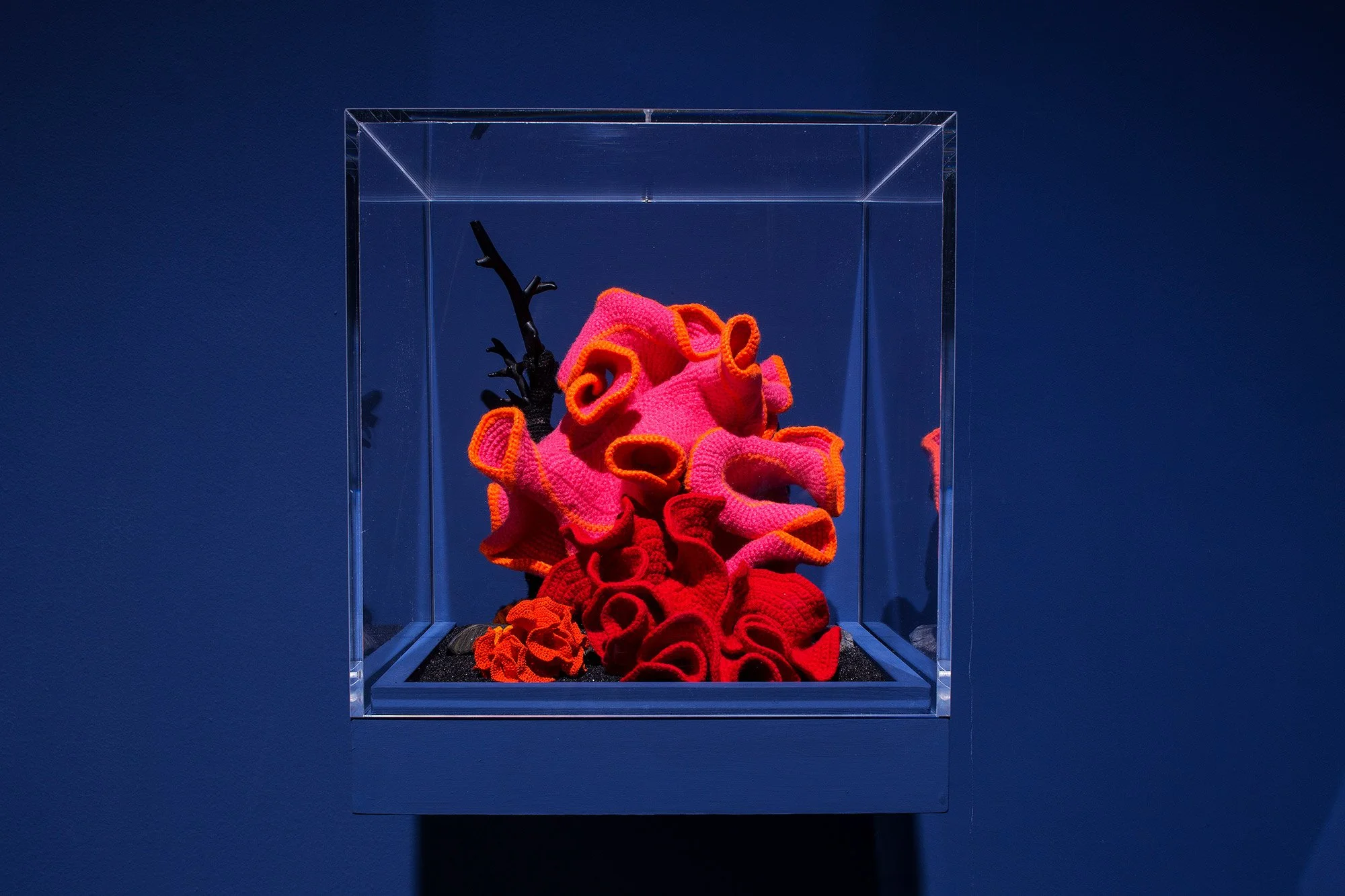
Pod World – Hyperbolic, at the 2019 Venice Biennale.
Crochet pieces by Christine Wertheim, Margaret Wertheim, Anitra Menning and Heather McCarren.
(photo© La Biennale di Venezia, by Italo Rondinella)
The origin of the project
The Crochet Coral Reef was initiated in 2005 by the Australian artists Margaret Wertheim and Christine Wertheim, founders of the Institute For Figuring.
More than play is at stake in this project. It was inspired by the decimation of the Great Barrier Reef in Queensland, Australia, where the Wertheim sisters grew up. After reading about coral bleaching caused by rising sea temperatures, Christine suggested crocheting a reef as a creative response. Far from being an arbitrary choice, crochet proved to be the logical medium: the crenellated surfaces generated by living reefs are biological manifestations of hyperbolic geometry — a structure that humans can most easily model through crochet.
Using this humble domestic craft, participants reproduce the complex geometries found in coral ecosystems. Crochet naturally produces hyperbolic forms, allowing people to physically explore non-Euclidean mathematical structures while reflecting on fragile marine environments. From this unexpected intersection of craft, mathematics and climate awareness, the project has evolved into a vast collaborative artwork. Communities around the world have taken up the challenge to create locally unique “Satellite Reefs,” transforming the Crochet Coral Reef into a distributed ecological sculpture. Time, contingency and collective participation all play a role in this unfolding process — much as they do in living ecologies, where chance and circumstance drive innovation and diversification.
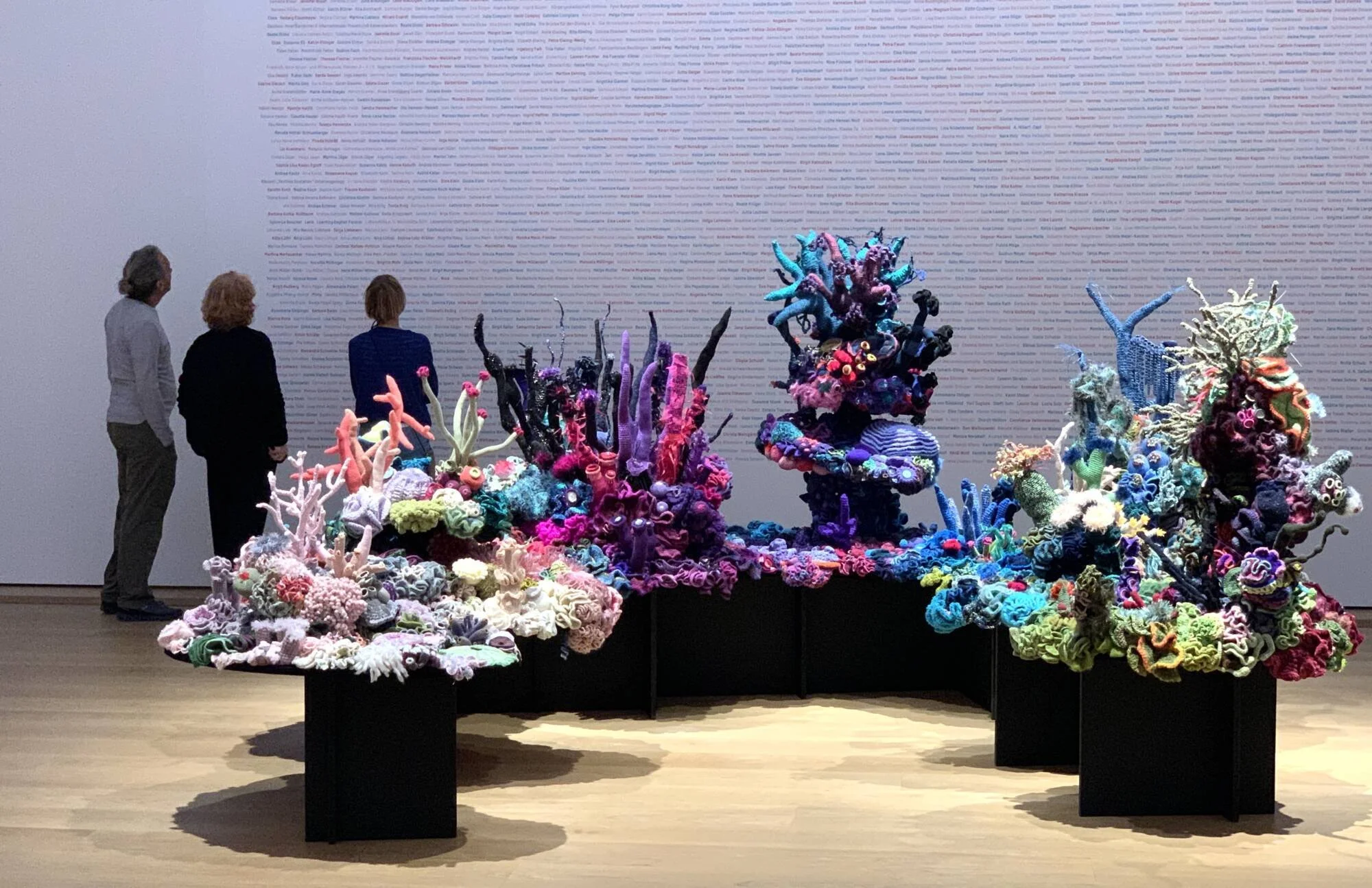
Baden Baden Satellite Reef at Musee Cantonal des Beaux Arts (Lausanne, Switzerland, 2024)
(photo© Institute For Figuring)
Art+Science
“Where living organisms create themselves through code – the DNA residing in their cells – so the Crochet Coral Reef is underpinned by a code, the pattern of stitches that describes each individual piece. [But] codes are only part of the ontology of things. In nature we see the same structures appearing in widely different branches of the Darwinian “tree of life.” Corals, kelps, seaslugs and cacti share similar hyperbolic forms, yet corals and nudibranchs are animals, while kelps and cacti are plants. Items in the Crochet Coral Reef that share the same code (or stitch pattern), may appear quite different when crocheted in different materials – an identical form made from stiff acrylic or floppy silk will have very different properties. We see here that matter matters, and what we make our sculptures from determines their look and feel as much as the codes they embody. Thus while the project functions through coding, material exploration is vital. New ‘species’ of crochet coral ‘organisms’ come into being as more diverse materials are incorporated: wool, cotton, silk, flax, soy yarn, plastic shopping bags turned into “plarn”, electrical cables, videotape, and military-grade electroluminescent wire, have all been used. As in the evolution of life on Earth, so the Crochet Coral Reef becomes an ever-more diverse taxonomy.”
The Belgian reef
In Belgium, the project takes the form of a collective process led by Isabelle Dumont, bringing together students, artists and citizens. Participants crochet small coral modules which will later be assembled into a monumental installation. In September 2026, the completed reef will be unveiled at the Musée L in Louvain-la-Neuve, forming a large-scale coral landscape composed entirely of contributions from the public.
Get involved
Anyone can contribute to the Belgian reef by crocheting coral forms or participating in workshops organised around the project. To learn more or join the initiative, please contact us via our form or the comment section at the bottom of this page.
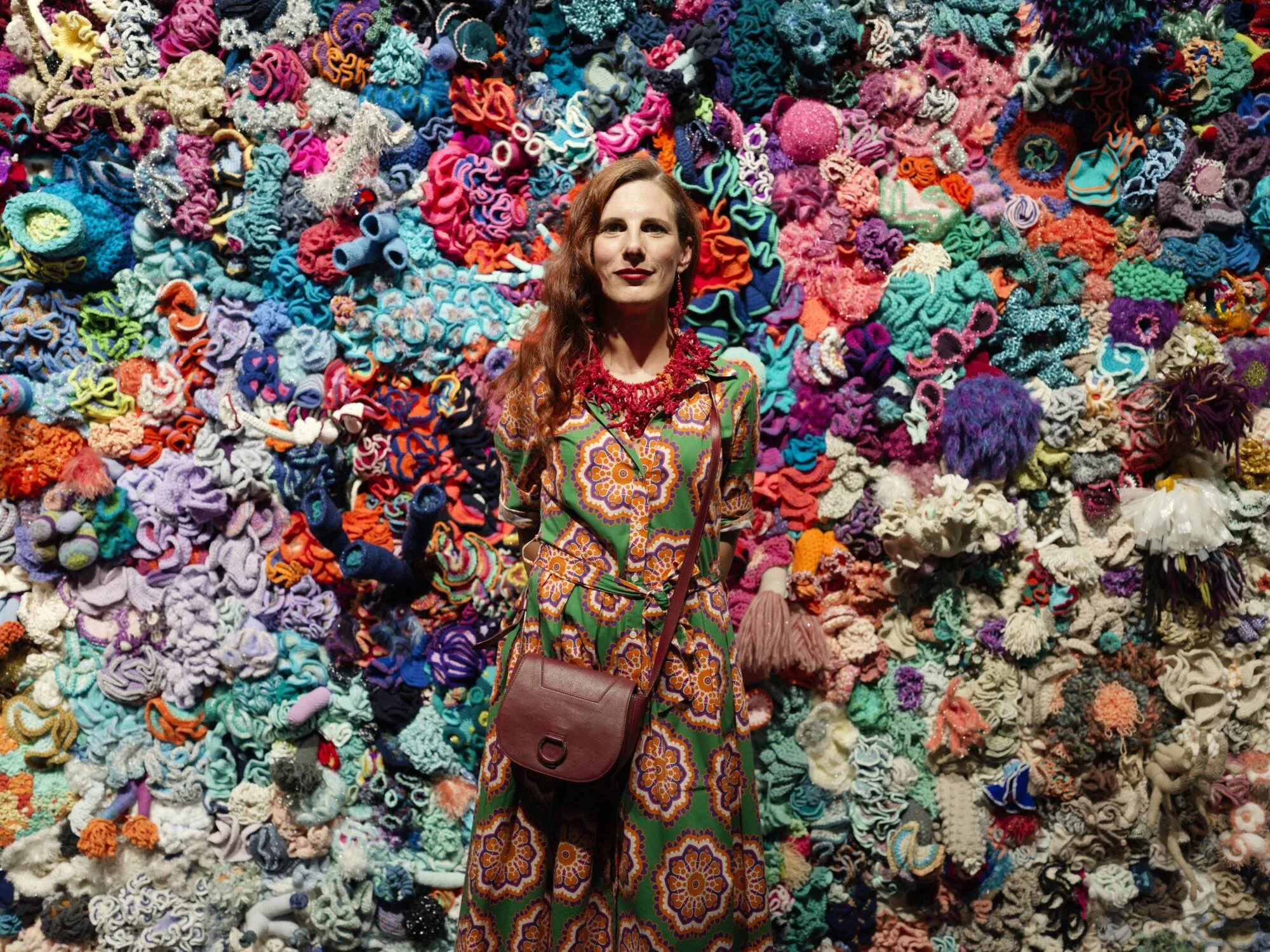
Five Fathoms Deep coral frieze from the Baden Baden Satellite Reef, with Romina Stahl.
(photo© Institute For Figuring)
Read more
Selected essays & interviews about the Crochet Coral Reef in academic journals, art magazines, and books.
Seeing the Unseeable: Data Design Art. (Forthcoming) Margaret Wertheim has a new essay about the Crochet Coral Reef as “vernacular natural history” and as a form of “embodied mathematics” in the catalog for the PST ART exhibition of the same name, held at ArtCenter College of Design (Oct 2024-Feb 2025). See Pdf here for a preview.
Feelings and Fractals: Wooly Ecologies of Transgender Matter.
An essay about the Crochet Coral Reef as a metaphor for queering, by scholar/curator Jeanne Vaccaro, in GLQ: A journal of Lesbian and Gay Studies (2015, Duke University Press)
Art Graft: Putting an “A” into “STEMM” in NatureVol 590 (11 Feb 2021) p351-353. Essay about scientists using art as an aid to creativity, featuring the Crochet Coral Reef
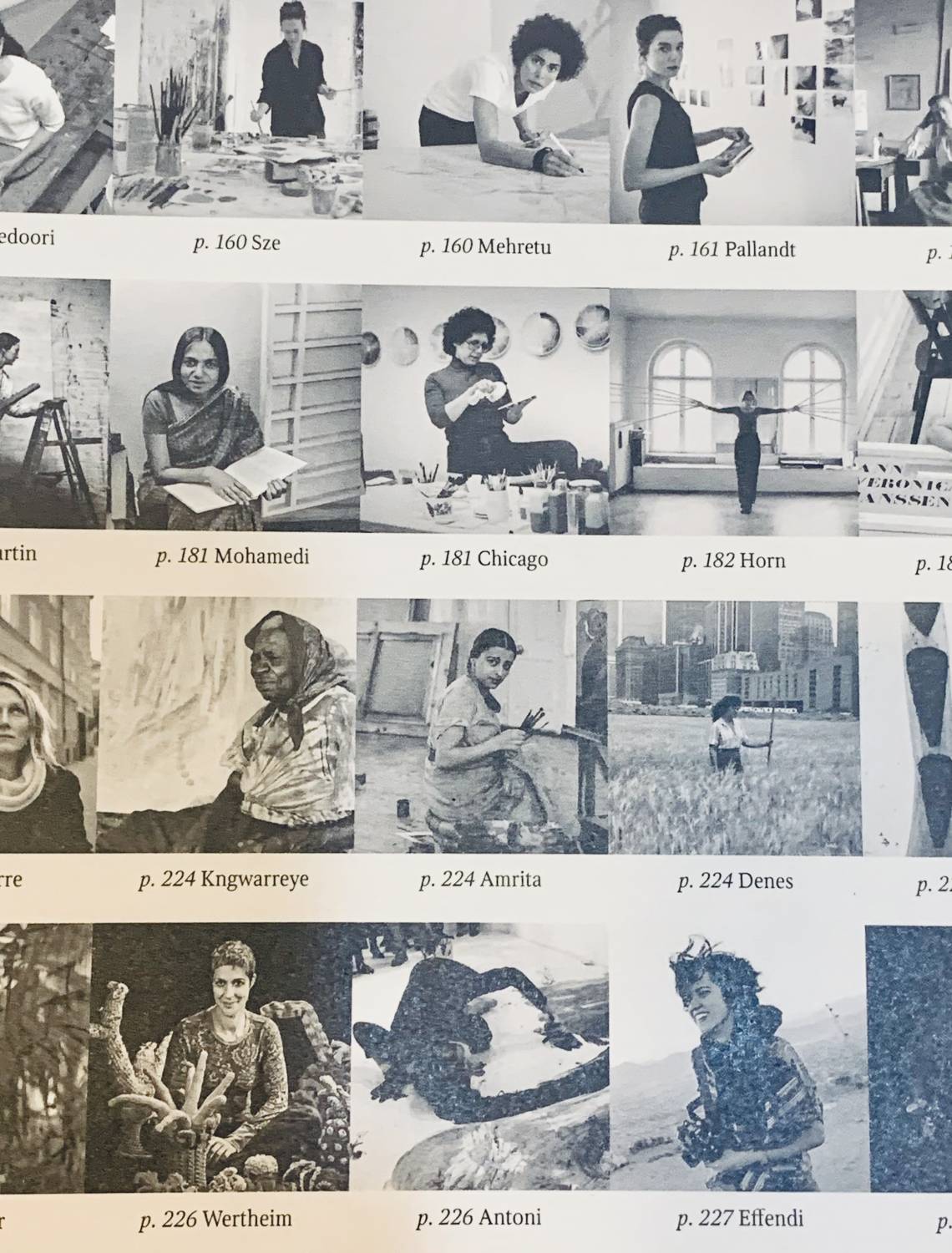
See All This, No, 20 Winter 2020/2021 – special international edition of Dutch art journal See All This celebrating women artists, edited by Catherine de Zegher. Featuring Crochet Coral Reef creators Margaret Wertheim and Christine Wertheim, along with Judy Chicago, Frieda Kahlo, Georgia O’Keefe, Leonora Carrington, Agnes Denes, Ruth Azawa, and more.


Antennae: The Journal of Nature in Visual Culture Issue 47 (2019)
Interview with Margaret Wertheim by journal editor Giovanni Aloi.
“Evolutionary Adventures in Seahorse Valley”
An essay about the Crochet Coral Reef as a form of synthetic biology, by Harvard Science Studies Scholar, Sophia Roosth. In Differences: A Journal of Feminist Cultural Studies Vol 23. No 3 (2012)
“Mechanics of moving defects in growing sheets: 3D small deformation theory” by Amit Acharya and Shankar C. Venkataramani
In Materials Theory,Vol 4, Article No 2 (2020), SpringerOpen
A research article on the mathematics and physics of how negative curvature surfaces can form in flexible materials, inspired in part by Margaret Wertheim’s writing about the Crochet Coral Reef. View pdf.
“Fingeryeyes: Impressions of Cup Corals”
In Cultural Anthropology, Vol. 25, No. 4 (2010)
An essay about the Crochet Coral Reef by cultural studies scholar Eva Hayward.
“The Institute For Figuring’s Crochet Coral Reef”
In Corals: Something Rich and Strange, Manchester University Press, 2014.
A book chapter about the Crochet Coral Reef by cultural studies scholar and curator Marion Endt-Jones. See here for the book’s beautiful Introduction to the subject of corals in art and culture.
“The Arts and New Materialism: A Call to Stewardship through Mercy, Grace, and Hope.”
In Humanities 2020, 9, 84. An essay refracting art, including the Crochet Coral Reef, though the lens of new materialist theory, by Nicholas Leonard.
“Margaret Wertheim: At Home in the Universe”
In Guernica, September 15, 2015.
Interview with Margaret by NYU scholar Tega Brain, on the boundaries of nature, gender bias in science, and inventing new geometric forms through crochet.
“Scenes from the Ocean: Feminist Interventions in Ecology”
In Marg Magazine, Vol 71, No 3. (March, 2020) p71-76
An essay about the Crochet Coral Reef and contemporary eco-feminist art by Heather Davies.